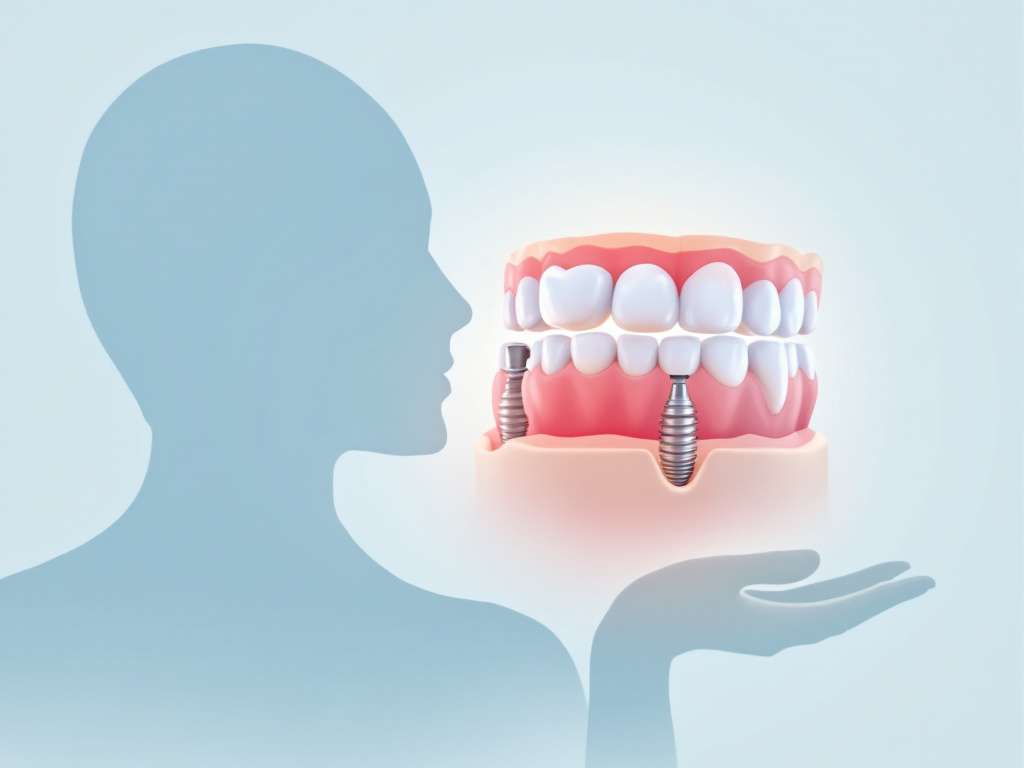
Understanding all-on-4
If you’re facing multiple missing teeth or an edentulous jaw, the all-on-4 implant procedure offers a streamlined solution that replaces an entire arch with just four implants. With strategic placement of titanium posts in denser parts of your jaw, it supports a full-arch prosthesis that functions like natural teeth and lets you leave the office with a new smile in a single day [1].
By consolidating support into four implants rather than placing individual posts for each tooth, you reduce surgical time, minimize trauma, and often avoid the need for extensive bone grafting. In many cases, this translates to lower overall costs compared with full-arch treatment plans that require eight or more implants.
Evaluating your candidacy
Not every patient is an ideal candidate for the all-on-4 implant procedure. It works best for individuals with significant tooth loss and adequate bone density in the anterior jaw, though moderate bone resorption can sometimes be addressed with grafting.
Your overall health plays a critical role. Conditions such as uncontrolled diabetes, blood clotting disorders, or immune system problems may increase surgical risks. Smoking and certain medications can impair healing, so candidacy assessments always include a review of lifestyle factors.
During an implant dentist consultation, your provider will perform 3D imaging, bite analysis, and a comprehensive medical review. They may also explore full mouth implant restoration if you need both upper and lower arches replaced in a coordinated plan.
Preparing for surgery
Before your implant day, expect a series of preparatory steps that set the foundation for predictable outcomes. Your team will conduct blood tests, digital scans, and a clinical exam to confirm you’re ready for surgery.
Digital surgical guides created from your CBCT scans enable precise angulation and depth control when placing implants. That accuracy reduces chair time and enhances the stability of the final restoration.
If you require preemptive procedures—such as a sinus lift or ridge augmentation—those steps are scheduled before or concurrently with implant placement. Your oral surgery team at an oral surgery implant clinic will coordinate bone grafting and implant staging to streamline your overall timeline.
Sedation options overview
Comfort and anxiety management are priorities during complex implant surgeries. Our sedation dentistry services cover multiple levels, from minimal to deep sedation.
- Oral sedation helps you stay awake but calm. You take a pill about an hour before surgery, which is ideal for mild to moderate anxiety. [2]
- Nitrous oxide, or laughing gas, provides rapid onset and recovery. You breathe it through a mask and remain conscious throughout.
- IV sedation delivers medication directly into your bloodstream for deeper relaxation. Most patients recall little or nothing of the procedure. (Learn more at iv sedation dental care)
- General anesthesia renders you fully unconscious and is reserved for extensive cases or high-anxiety situations.
Bone graft considerations
Healthy jawbone is crucial for implant stability. When bone volume has decreased, bone grafting may be necessary before or during implant placement. Bone graft dental surgery restores lost volume and creates a solid foundation for your implants.
Types of bone grafts
Autografts use bone from your own body, often the hip or chin, offering the highest compatibility. Allografts come from donor tissue processed to remove antigens. Xenografts use animal-derived bone, typically bovine, which provides a natural scaffold for new growth.
Integration timeline
Grafted bone needs time to fuse with your natural jaw, usually three to six months. An experienced implant and bone graft specialist monitors healing to determine the optimal window for implant placement. In some cases, your surgeon may coordinate a graft & implant combination in a single visit to reduce overall treatment time.
Implant placement process
On the day of surgery, your oral surgeon will remove any remaining diseased gum tissue and failed teeth, then expose the underlying bone.
Tissue removal and site prep
After administering your chosen sedation, the surgeon makes small incisions to access the jawbone. Precise cleaning of the site removes infection and prepares soft tissue margins for suturing around implants.
Drilling and placement
Using digital guides, pilot holes are drilled at exact angles to maximize support in denser bone regions. Four titanium implants are inserted and torqued to the manufacturer’s specifications to ensure primary stability.
Immediate loading
Once the implants are secure, a prefabricated prosthesis or a lab-processed provisional is attached to the posts. This immediate restoration step lets you walk out of the office with functional teeth the same day.
Immediate temporary restoration
Your provisional prosthesis delivers both form and function while you heal. It restores chewing ability, supports facial structure, and provides a natural aesthetic.
Within hours, you leave with a complete smile.
Benefits of all-on-4
One of the biggest advantages of the all-on-4 implant procedure is a fully restored bite force that lets you enjoy a varied diet again.
By stimulating bone in regions where teeth are missing, this technique prevents the jawbone resorption and facial collapse often seen with long-term denture wear.
Because the prosthesis is fixed, you never have to remove your teeth for cleaning. This permanence boosts confidence, speech clarity, and social comfort.
Compared with replacing each missing tooth with its own implant, all-on-4 often proves more cost-effective. You trade eight or more implants for just four, which can lower both surgical fees and restorative costs.
Long-term outcomes
The all-on-4 protocol is FDA-approved and has demonstrated a long-term success rate of up to 98% [3].
With proper care, many patients enjoy their restorations for 20 to 25 years or longer. Regular maintenance and good oral hygiene can extend that lifespan indefinitely.
Clinical studies report 93% patient-level and 98% implant-level survival after five years in the upper jaw, with lower-arch bridges surviving at 99.2% after ten years and upper-arch bridges at 100% after five years [4].
Beyond survival statistics, patients consistently report improved quality of life. Enhanced eating ability, clearer speech, and renewed self-esteem are among the most commonly cited benefits.
Maintenance and care
Caring for an all-on-4 prosthesis is much like maintaining natural teeth. Brush twice daily with a soft-bristled brush and nonabrasive toothpaste.
Flossing with specialized implant floss or interdental brushes prevents food particles from lodging under the prosthesis.
Attend regular follow-ups with your implant care and maintenance team. During these visits, your provider checks for wear, evaluates peri-implant tissues, and makes minor adjustments as needed.
Avoid habits such as smoking or biting hard objects to protect your investment and support long-term success.
Financing and costs
The average cost of an all-on-4 implant procedure ranges from approximately $12,000 to $25,000 per arch, depending on materials, location, and your clinical needs [5]. At Dr Max Arocha’s Plantation, FL clinic, a permanent set begins at about $24,889 per arch, while a two-stage all-inclusive option starts at $12,889 [4].
| Cost option | Price | Notes |
|---|---|---|
| Permanent full-arch at Dr Arocha | $24,889 per arch | Includes extractions and fixed teeth |
| Two-stage all-inclusive at Dr Arocha | $12,889 per arch | Covers surgery, implants, and provisional |
| Average market range | $12,000–$25,000 | Depends on clinic, materials, and location |
Many dental insurance plans cover extractions and preparatory work but not the implants themselves. Financing through options like LendingClub offers fixed-rate monthly payments without prepayment penalties [4].
Financing can make treatment manageable.
Selecting your provider
Choosing the right team can significantly impact your comfort and outcomes. Seek credentials in both sedation & implant dentistry and graft & implant combination techniques.
A clinic that offers complex restorative dentistry and full mouth rehab dentistry can coordinate all phases under one roof for streamlined care.
Ask to see before-and-after portfolios, review success rates, and read patient testimonials to gauge real-world results.
Finally, schedule your implant dentist consultation to discuss sedation plans, bone grafting needs, and long-term maintenance tailored to your goals.